
Some Quite Interesting facts about MRI scanners (and moving them)
To patients, an MRI scanner is merely a piece of equipment that creates detailed images of their body, enabling radiologists to look at soft tissues like the brain, spine, joints, and organs in extraordinary detail. But have you ever stopped to think about the fascinating science and complexities involved in making these marvels of modern engineering accessible to patients?
Here are some Quite Interesting facts about MRI scanners, and what it takes to install them on sites such as SCP Radiology’s branches in Cape Town and beyond.
Characteristics of MRI scanners
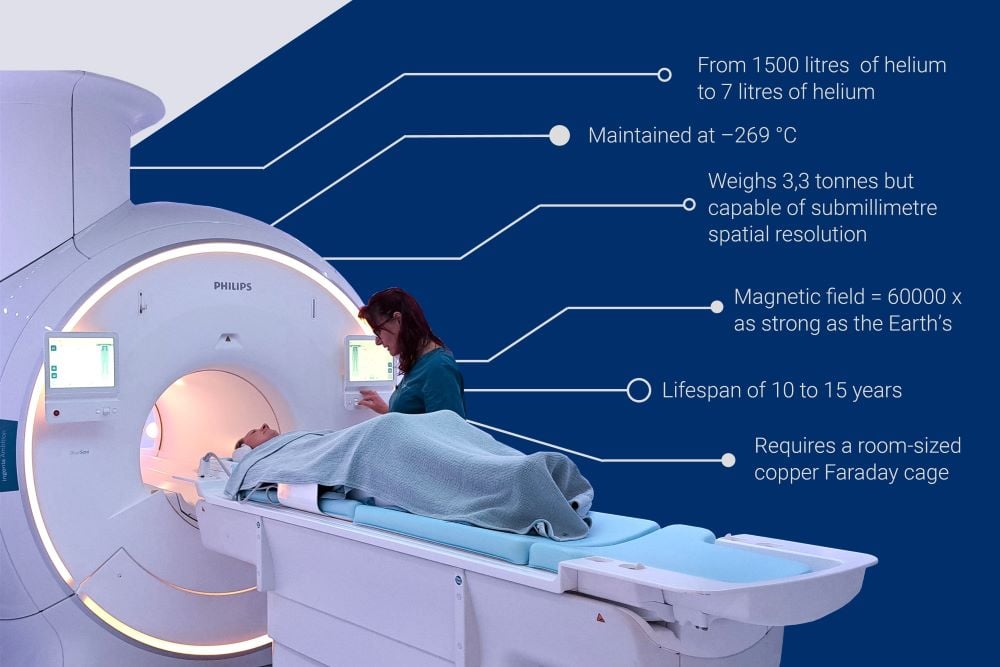
• New low-helium machines, such as the one recently installed at SCP Radiology Louis Leipoldt, weigh 3.3 tonnes each.
• An MRI scanner has many magnets, but the main one has a magnetic field that is thousands of times stronger than the Earth’s magnetic field.
• A conventional MRI system needs around 1 500 litres of helium to operate and keep the magnet cool – plus it needs to be topped up at regular intervals.
• The latest-generation, low-helium machines use 7 litres of helium each throughout their lifespan.
• The newer MRI systems use sealed magnets that, although having to be kept at a temperature of 4 Kelvin (-269.15° Celsius), require very little helium and no refilling over their lifetime.
• The lifespan of an MRI machine is between 10 and 15 years.
Why do manufacturers and radiologists choose low-helium MRI technology?
• Around 32% of the current global helium consumption is used in MRI machines (NASA is the global leader in helium consumption).
• Helium is a non-renewable, relatively scarce resource – the shortage is exacerbated by geopolitical pressures.
• A quench – the rapid, unplanned discharge of a superconducting magnet releasing all the helium in minutes – is extremely expensive and in a third of cases means a downtime of the machine in excess of three days.
• One of the solutions to these issues is the development of systems that are no longer dependent on helium. No quenching is required for this new, low-helium MRI machine.
ALSO READ: The science and challenge behind replacing MRI machines
Quite Interesting facts about MRI room preparations
• A Faraday cage – in the case of our Louis Leipoldt branch, constructed out of copper to exact specification by a supplier in the Netherlands, then shipped to SA – surrounds the MRI machine.
• Copper is used as it’s a non-ferrous metal and an excellent conductor of electricity (aluminium can also be used).
• The cage is used to keep external radiofrequency signals out (so that they do not interfere with the MRI) and keep MRI radiofrequency signals in (to prevent these signals from affecting other equipment).
Quite Interesting facts about moving and installing an MRI scanner
• A transport and rigging company, with a crew of 10, was responsible for the safe delivery and installation of the MRI machine. The company has helped deliver and rig healthcare machines for SCP Radiology for over a decade.
• Challenges for this particular installation included: The MRI machine being housed on the first floor; height restrictions at the building entrance; having to construct a special platform outside the building for loading; the overhang from the second floor; and traffic management during offloading.
• The wall needed to be opened up for the removal of the old machine and the delivery of the new machine.
• In addition to the 3.3-tonne MRI machine being delivered, a total of 90 boxes containing additional electronic equipment and supplies (the backend) were also offloaded.
SCP installs three MRI scanners in 2026
At the end of 2026, SCP Radiology will have upgraded three of its existing MRI machines to ensure patients’ access to the latest imaging technology. The three facilities having their MRI machines replaced this year are:
- SCP Radiology Louis Leipoldt (at Mediclinic Louis Leipoldt in Bellville): Completed
- SCP Radiology Vredenburg (at Life West Coast Private Hospital in Vredenburg): 24 July to 13 September
- SCP Radiology Worcester (at Mediclinic Worcester in Worcester): 1 August to 7 September
Patients can continue to make MRI bookings online or contact our MRI Central Bookings department at booking@scp.co.za or 021 100 6600.


